

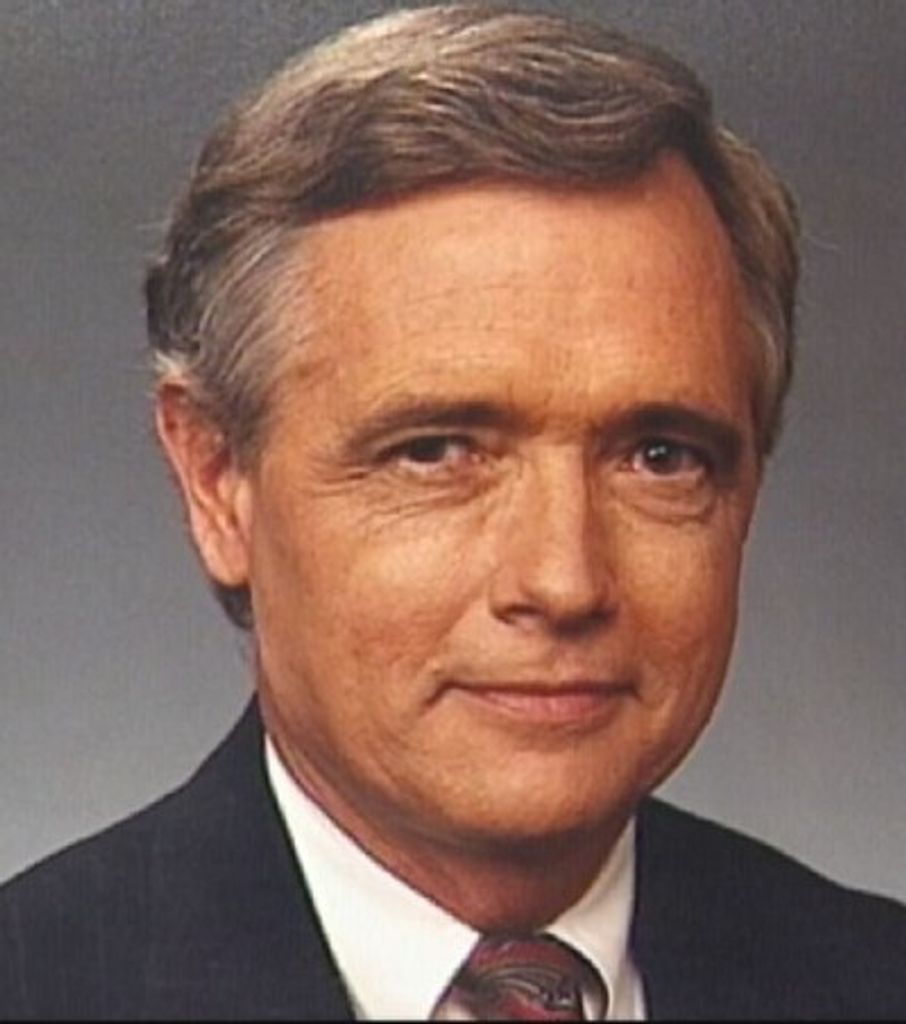
IN LOVING MEMORY OF

Clayton Rush

Clayton Rush Vaughn Profile Photo

Vaughn

Jan 12, 1935 — Mar 3, 2021

Tulsa

Obituary

Clayton Vaughn, who earned a reputation as the dean of Tulsa television during a broadcasting career that spanned more than 40 years, has died. He was 86. Services will be held later. Vaughn's career took him to the nation's biggest markets, but he was always drawn back to Tulsa. He spent more than 30 years at KOTV, Channel 6, much of the time in the roles of news director, evening anchor and, later, managing editor. He retired from KOTV in 1998.

Born Clayton Rush Vaughn in Pittsburg, Kansas, on Jan. 12, 1935, Vaughn was raised in Cushing. He was active in high school speech competitions and was recommended by a speech teacher when, in 1953, a new radio station in Cushing sought help from the high school ranks.

Vaughn had not considered entering the broadcasting field before the opportunity, according to a voicesofoklahoma.com biographical interview with John Erling. And, said Vaughn, "After 1953, I never had a job that wasn't in broadcasting."
Vaughn's longtime Tulsa association began when he accepted a $350-a-month job as a newsman with a rock 'n' roll station, KAKC, in 1958. He then made his way up the broadcasting ladder, working for television stations in Tulsa, Los Angeles and New York.
In 1969, Vaughn moved to Los Angeles to work for KABC and met his wife, Nancy, when they were seated together to cover the Charles Manson trial.
Vaughn, during his voicesofoklahoma.com interview, said he attended a news conference at Bob Hope's home while working in L.A. Vaughn asked a question. Hope started his reply with, "Well, Clayton."

"Whoa! And then I realized that I was his local news guy," Vaughn recalled. "He knew my name because I was on television. I was just simply stunned at that."

Vaughn returned to KOTV in 1971 and became the anchor of Oklahoma's first 6 p.m. news hour, which brought magazine-style reporting and news commentary to Tulsa TV. In 1979, he went to work for WNET-TV in New York City and the New Jersey Public Television System. He returned to KOTV in 1981.
During the course of Vaughn's career, he reported from nine national political conventions, traveled to Vietnam to report on area military servicemen and women, anchored from the Oklahoma City federal building bombing site, presided over scores of political debates and interviewed people from all walks of life.
Vaughn was inducted into the Oklahoma Broadcasters Hall of Fame and received a lifetime achievement award from the Heartland Academy of Television Arts and Sciences. He was in the inaugural class when the Tulsa Press Club began honoring Tulsa TV icons in 2003.

Former KOTV colleague Glenda Silvey provided a statement about Vaughn. "Some of us tend to lionize journalists of the past, but I consider Clayton more than worthy of it," Silvey said.

"Over all the years I worked with him, I never saw him waver from the highest journalistic standards, such as objectivity, fairness, accuracy and excellent writing.

"Watching Clayton deliver a news story, one would never have any idea what his opinion was on that story, something sadly missing in too much of today's broadcast journalism. He modeled the highest news integrity as a leader of KOTV's newsroom and was an exemplary teacher to many.

"I have many funny memories of his scaring new reporters — dazzled by his reputation — by interrogating them on their work, correcting their grammar, or asking them if they understood the meaning of words they'd used. He was always kind, though; often humorous, and they learned from him.
"He's one of the most significant professional and personal relationships of my life. It's hard for me to imagine no longer being able to talk with Clayton."

After retiring from broadcasting, Vaughn became executive director of the Tulsa Historical Society, where he served through 2006.

"I had never had an association with a museum except to walk through them," he once told the Tulsa World. "I didn't know anything about nonprofits, except for being on a few boards."

But, under Vaughn's leadership, the Tulsa Historical Society grew from a practically "homeless" organization with an annual budget that never topped $60,000 to one with an endowment of $1.1 million, an annual budget that has grown to $650,000 and a stately mansion adjacent to Woodward Park.
To send flowers or plant a memorial tree in memory, please visit our flower store.

Guestbook

Visits: 114

This site is protected by reCAPTCHA and the
Google Privacy Policy and Terms of Service apply.

Service map data © OpenStreetMap contributors